August 29, 2018

The Incredible Story of Four Nuns Trapped in the South Pacific during World War II. There only means of Escape---via Submarine

IT MAKES SENSE TO ME

By Larry Peterson

Trapped in Paradise–true story from WWII in the Pacific
Sisters of St. Joesph of Orange  pd


There is a touch of irony to this story. On July 8, 2018,  Aleteia ran a story about Our Lady of Puy. This is the site of the Blessed Mother’s very first apparition after her Assumption into Heaven. The irony is in what follows.

The Sisters of St. Joesph are a worldwide organization representing more than 14,000 Sisters around the world. The Sisters of St. Joseph of Orange is the congregation based in California and was established in 1912 by Mother Bernard Gosselin. It is one of many congregations worldwide. In 1966 The Federation of the Sisters of St. Joseph, which comprise all the congregations in the United Staes, was formed; all having their origin in LePuy.

This is about four nuns from California who somehow became stranded behind Japanese enemy lines during World War II.  They happened to be members of the Sisters of St. Joseph of Orange. The foundation for this order was set in place in LePuy, France, in 1650. As the Feast of the Assumption approaches, it is an honor to mention them.

Two of the Sisters were teachers, and two were nurses. They had arrived in the Solomon Islands in December, 1940. These young women were new to missionary life, confronting an unknown culture for the first time, and did not speak the languages spoken on the different islands. Also, they had to learn how to get around the jungle. One year after they arrived, the Japanese attacked Pearl Harbor.

The Japanese quickly occupied many of the islands in the South Pacific. The nuns had been deeply involved in a village on the island of Buka. They had no idea that the Japanese wanted Buka for an airfield. Sister Hedda Jager was the nun in charge of journaling their experiences. No matter what kind of day she was having, she always managed to record the day's happenings.

As the Japanese get closer and closer Sister Hedda records how their lives morphed from working as missionaries to being filled with sheer terror as the invading Japanese got closer and closer. They made it to Bougainville where they learned  how other missionaries in the Solomons had been tortured and executed.

There were Marist missionary priests on the island and, knowing what the fate of the nuns would be if captured, managed to hide the Sisters for months in the jungle. On New Year’s Eve, 1942, the priests managed to get the Sisters and twenty-five others, to the beach in Teop Harbor. It was then they all learned that a submarine would be their means of rescue.

On New Year’s Day,1943, in the early morning darkness, the submarine Nautilus, pulled to within 100 feet of the beach and the terrified passengers were safely taken on board and brought to safety. Sister Hedda wrote in her journal: “You cannot put into words the feeling that one has for those of one’s own country, especially when one is miles from home and running away from the Japanese.”

When the war ended the four Sisters returned to Buka to continue their work. The last of them passed away in 1999. These Sister of St. Joseph of Orange will forever remain a true inspiration to us all.
The book by Sister Hedda; Trapped in Paradise, can be found at the link below
https://www.amazon.com/Trapped-Paradise


        copyright ©Larry Peterson 2018

May 22, 2014

On Memorial Day, 2014: The Bataan Death March; a Microcosm of American Exceptionalism

by Larry Peterson

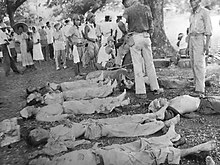
Soldier's Bodies left along the road at Bataan
The Memorial Day weekend of 2014 is upon us. It is the day when we honor all those who, throughout the course of our  history, have given the ultimate sacrifice for their nation, for the freedom(s) it represents and, foremost,  for all Americans, past, present and future.  I write now about a brief time period encapsulated in that history.  I doubt that most  of today's high-school and college students have ever heard about this.  It is known as the  Bataan Death March and it is one of the most brutal and inhuman periods that occupy the pages of our own history. The Bataan Death March began on April 9, 1942 and ended sometime in May of 1942.

 On Sunday, December 7, 1941, the Japanese Empire launched a sneak attack on the United States at Pearl Harbor, Hawaii.  America was now officially part of World War II.  As the New Year of 1942 dawned, the Japanese were running almost undeterred through the South Pacific and the battle of the Philippine Islands was underway.  On January 7, 1942, the Battle of Bataan began.  (Bataan was a peninsula on the southern end of the Philippines and was the gateway for the Japanese army via the South China Sea.)  Three months later, on April 9, the remaining American and Filipino soldiers finally surrendered to overwhelming Japanese forces. The infamous Bataan Death March was about to begin.

The surrender by the American and Filipino forces at Bataan was viewed by the Japanese soldiers as "cowardice".  They believed that the defeated soldiers had been disgraced and should have committed suicide. Consequently, when they had rounded up the approximately 60,000 Filipino and 15,000 American soldiers, they held them with utter contempt. They were ordered to march the prisoners to "Camp O'Donnell", an 80-mile journey through the bug infested and sweltering jungle heat of the Philippines. Before the journey had even begun the captors were treating their prisoners as if they were nothing more than dogs.

The thousands of prisoners were divided into groups of about 100 men and the Bataan death march  began. The exact figures are unknown but it is believed that thousands of troops died because of the sheer brutality of their captors.  The men were starved and  deprived of water.  If they fell they were beaten and, depending on the Japanese soldier guarding them, sometimes bayoneted.  Decapitation by sword  was not uncommon. Thousands died later from from disease.  General Masaharu Homma, was the  commander of the Japanese forces in the Philippines.   In September of 1945, he was arrested by Allied troops and indicted for war crimes. The court found that Homma had permitted his troops to commit "brutal atrocities and other high crimes". He was sentenced to death by firing squad and was executed on April 3, 1946.

This is only a tiny portion of the people that we Americans honor on Memorial Day. They were folks like us: husbands, fathers, sons, brothers, and grandfathers. Many were still teenagers. They  believed in God,  had honor and loved their country. They liked baseball and football and music. They fought for us, they suffered for us and many died for us. And please do not think for a minute that women were not a part of this. Click on the link and read about the "Angels of Bataan".

The legacies left behind, the courage displayed by so many, the sacrifices of lives given in defense of the United States of America and her ideals represents the finest in God's human creations.  I hope and pray our young people are being taught our exceptional history from the Revolutionary War down through the war taking place at this moment in that God-forsaken place called Afghanistan.  On Memorial Day all Americans owe our fellow and sister Americans who have served in these places a moment of prayer and a THANK YOU.  And, as always, may GOD BLESS AMERICA.